Showing posts with label Artist Post. Show all posts

Tuesday, March 10, 2015

Asher Benson


Source 
Source

Asher Benson is an Illustrator/Vector Artist. She has been active in the vector community of DeviantART for the past 9 years and currently works as a contracted Vector Artist/ Freelancer. Her work focuses on around color and it's application of it line segment by line segment.[1]  Her favorite Adobe Illustrator tool/effect is Gaussian Blur.[2] She was featured in Adobe's Master Class: Illustrator Inspiring artwork and tutorials by established and emerging artists book published in 2012.[1] Being part of the DeviantART community she spends often publishes tutorials as well as various stages of her pieces.


Source
Source
Benson normally starts with a sketch and using that as a locked base for her work. It is very eye catching work that is apealing to the eye. Benson stated that her work with vectors "that complex and mathematical program" changed her life. "I was a person who was very afraid of color and mistakes, I worked lightly and hated the idea of permanence. With Adobe Illustrator, I have come out of my shell and brightened my drab and dreary world with explosive color and experimentation"
That color is seen clearly in her work. The play of gradients the shades. All of it is a way to bring a emotion to an seemingly boring and format. Her colors bring light and emotion even when using a more subdued pallet such as the piece bellow.
Source

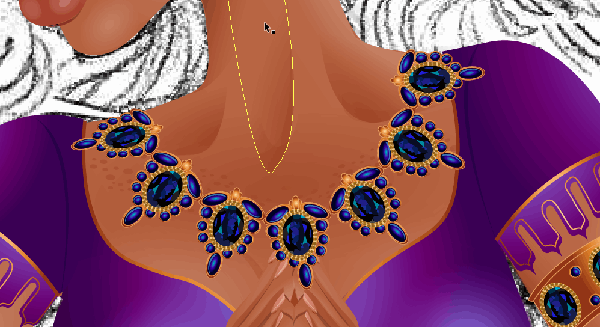
Benson's artwork is amazingly detailed. Her manipulation of shading using gradients brings a great deal of depth to her images. Her layers upon layers of shading and detail to the body and it's accessories makes it so there is always something new to see when looking at once of her pieces. Despite the non-realistic style of her drawings the images still have an amazing control of anatomy and texture, whether it be jewelry or the folds of clothing. Her work takes sketching and then uses the benefits of vectors to give is more depth and detail than possible in another format.
Source

Source

Thursday, January 22, 2015

Douglas Davis

Douglas Davis Source
Douglas Davis is most well-known for his art in the 1970s that used the relatively new tools of video camera and satellites to break geographic boundaries when presenting his art. This work started as early as 1971 with the Electronic Hokkadim which was and interactive broadcast performance from the atrium of the Corcoran Gallery, Washington D.C.[1] But the most notable piece was in 1977 when Davis joined with Nam June Paik and Joseph Beuys for The Last Nine Minutes? which was the first live international satellite telecast by artists, transmitted from Documenta 6 in Kassel, Germany to twenty-five other countries.[3]

Clip From The Last Nine Minutes? Source

Davis' work continued to transform with the technology available using mediums such as the World Wide Web. The participatory project was called The World's First Collaborative Sentence that started in 1994  but continued and grew for six years.[1] In the end the piece including text from 200,000 individuals. The sentence is still available here as the Whitney Museum of American Art in New York modified the coding so that it could be compatible with the modern day websites in an attempt to continue the endeavor indefinitely.

For his work Davis was trying to forge a connection with his audience, his viewers in a way that would create a sort of conversation and debate whether it was about the technology he used and what it could be used for but also what it should be used for and why. He challenged the way the medium was seen.
 "Television is usually considered a public medium, but because of the way it is experienced — in a personal space — it is in fact quite private. When I began to work overtly with the medium, I acted out of the same sense." -Douglas Davis[2]
Davis' work called for an active viewer as he used a medium (television) that normally called for passivity.

I believe that Davis made a remarkable start in easily accessible interactive art. Ideas such as his were the building blocks for such sites as YouTube. His work didn't start a community as much as the latter but it started a dialogue between the artist and the viewer that up until that point could only be reached by performance artists; who were hard to reach.  The intimacy that Davis talks about can be viewed as even stronger than that of a in person performance artist because despite the fact that there is a screen between the view and Davis he is, in a way, closer to the view than are performance artist can manage. It is that degree of intimacy that makes his work so compelling because it not only calls for the viewer to participate but it makes them want to.  

[1]"Douglas Davis Timeline." Timeline. Web. 21 Jan. 2015.
[2] "Douglas Davis Biography." Electronic Arts Intermix. Web. 21 Jan. 2015.
[3]Paul, Christiane. Digital Art. New York: Thames & Hudson, 2003. 18-21. Pdf.